
Guangzhou, the core hub of global merchandise distribution, attracts countless buyers every year. But what you may not know is that today's savviest buyers no longer fly to Guangzhou in person.
A procurement revolution driven by digitalization is unfolding here. Remote ordering is no longer just a theoretical concept—it has become a proven, efficient supply chain strategy. The real challenge has never been distance; it's whether you have mastered a systematic approach: from a precise sourcing brief, to rigorous sample sealing, to full-process third-party inspection and logistics integration.
This article will unveil this practical framework, enabling you to source quality products from Guangzhou markets accurately and safely, just like a local sourcing expert, no matter where you are.
Is Remote Sourcing from Guangzhou Markets Feasible?
Absolutely. As one of the world's largest merchandise distribution centers, Guangzhou's wholesale markets (such as Sanyuanli Leather Goods, Liuhua Clothing, Zhongda Fabric, and Shisanhang Garment District) have long been deeply embedded in the global supply chain. Over the past three years, the inability of numerous overseas buyers to visit in person has instead pushed Guangzhou's markets to complete a digital upgrade of their remote sourcing processes.
Today, remote sourcing from Guangzhou is no longer a question of "whether" it can be done, but "how well" it can be executed. As long as you have clear processes, reliable partners, and reasonable risk controls, you can place orders just as accurately from your office in New York, London, or Dubai as if you were standing at a booth. However, it's important to recognize: remote sourcing does not mean "virtual window-shopping"; it requires a more systematic methodology, not casual WeChat price inquiries.
Submit a Sourcing Brief First, Not a Generic Price Inquiry
This is the first and most common mistake remote buyers make—picking up their phone and sending a supplier a message: "How much is this?" In Guangzhou's wholesale markets, this type of inquiry almost signals: "I'm an amateur, please quote me a inflated price."
The correct approach is: First prepare a formal Sourcing Brief. This document should include at a minimum:
Detailed specifications of the target product (material, dimensions, color, packaging requirements, weight/thickness quantifiable metrics, etc.)
Estimated order quantity (clearly differentiate between initial trial order and stable long-term volume)
Target price range (not a single number, but an acceptable upper and lower range)
Delivery timeline requirements
Certification/testing standards (if any)
Reference images or competitor product links (at least 3–5 multi-angle actual photos)
Send this brief uniformly to a shortlist of potential suppliers and ask them to respond point-by-point. This approach offers three benefits:
1. It filters out unprofessional middlemen.
2. It signals to suppliers that you are a serious buyer.
3. It provides a unified benchmark for subsequent price comparisons and negotiations, avoiding "apples-to-oranges" comparisons.
How Can Remote Buyers Find and Compare Guangzhou Suppliers?
The channels for remote supplier discovery are now well-established. The key is to use them in combination and cross-verify:
| Channel | Purpose | Cautions |
|---|---|---|
| Alibaba International Station / 1688 | Initial screening, checking company credentials | Distinguish between trading companies and factories |
| Guangzhou specialized market online platforms (e.g., LiuhuaMall, Guangzhou Textile Net) | Identify booths within specialized markets | Information updates can sometimes lag |
| Online matchmaking for industry exhibitions (Canton Fair online platform, various vertical industry fairs) | Access reputable exhibitors | Exhibitors typically have better credentials |
| TikTok/Douyin booth live streams | Real-time product viewing, getting a feel for the booth atmosphere | Ask streamers to show details and tags |
| LinkedIn / Industry communities | Cross-verify supplier reputation | Search for supplier name + "complaint" keywords |
When comparing suppliers, remote buyers should establish a scoring system. Suggested weightings:
Response professionalism (15%) — Did they respond point-by-point to the brief, rather than giving vague answers?
Completeness of credentials (20%) — Business license, export qualifications, factory audit reports.
Sample quality (30%) — Discussed in detail below.
Communication efficiency (10%) — Response speed, language ability.
Price competitiveness (15%) — Reasonableness of the quote for the same specifications.
Historical client references (10%) — Can they provide verifiable export records?
Special note: Do not merely look for the lowest price. There's an old saying in Guangzhou markets: "If you bargain too hard, the goods won't match the sample." In remote transactions, a reasonable price is far more important than the absolute lowest price.
Why Are Samples Even More Critical for Remote Shopping?
If you were in Guangzhou, you could visit the booth to feel the fabric, inspect the workmanship, weigh the item, and measure it yourself. In a remote scenario, all this information must be conveyed through samples. The importance of samples in remote sourcing is elevated to a core decision-making element for three reasons:
First, samples are the only physical evidence of quality. Photos can be retouched, videos color-adjusted, and descriptions exaggerated, but the sample that arrives at your doorstep is real. It's advisable to ask the supplier to send two samples: one for your records and one for destructive testing (e.g., tensile tests, wash tests, abrasion tests).
Second, samples are a litmus test of the supplier's sincerity and capability. A truly capable factory will proactively suggest sampling and may even offer improvement suggestions based on your brief. Those who make excuses, demand exorbitant non-refundable sample fees, are often middlemen with overly long supply chains.
Third, mass production consistency depends on sealed samples. In remote sourcing, once a sample is confirmed, both parties must sign and seal the sample (keeping one sealed sample with the supplier and one with you or your agent). Subsequent mass production acceptance will be based on this sealed sample.
About sample fee negotiation: A reasonable approach is for the buyer to bear the sample cost, but for it to be refunded upon mass production order placement; or for the supplier to provide standard samples for free, while charging a reasonable fee for custom development. If a supplier is unwilling to cooperate on samples, it's advisable to eliminate them from consideration.
How Can Buyers Control Product Quality Without Being in China?
This is the core anxiety in remote sourcing, and it's also the area with the most developed solutions. The essence of quality control is not "whether you are on-site," but "who is representing you on-site" and "what standards are being used."
The three-tier defense for remote quality control:
Tier 1: Pre-production QC
After the supplier confirms the order but before formal production begins, request a virtual pre-production meeting (via Zoom/WeChat video) to confirm point-by-point: raw material batches, production schedule, key process control points, and packaging solutions.
Request the supplier to provide samples of raw materials/auxiliary materials or certificates of their suppliers (e.g., fabric test reports, environmental certifications).
Tier 2: During Production Inspection (DUPRO / In-line Inspection)
When production is approximately 20%-30% complete, commission a third-party inspection company (such as SGS, BV, Intertek) or your Guangzhou sourcing agent to visit the factory for a mid-production inspection.
The focus of this inspection is on semi-finished product dimensions, whether the workmanship conforms to the sealed sample, and whether the production line is stable. Problems found at this stage have the lowest rework cost.
Tier 3: Final Random Inspection (PSI / Pre-shipment Inspection)
When 100% of the mass production is complete, packed but not yet boxed, conduct the pre-shipment inspection. Follow internationally accepted standards like ANSI/ASQ Z1.4 (or MIL-STD-105E) for random sampling, checking appearance, function, dimensions, packaging, and labeling.
The inspection report should include photos and videos, and the remote buyer should give online confirmation before arranging shipment.
Supplementary advice: Establish quality penalty clauses in the contract—for example, if major defects exceed the allowable AQL level, the supplier must bear rework costs or air freight charges. This is far more effective than post-hoc disputes.
How to Consolidate Remote Orders from Guangzhou?
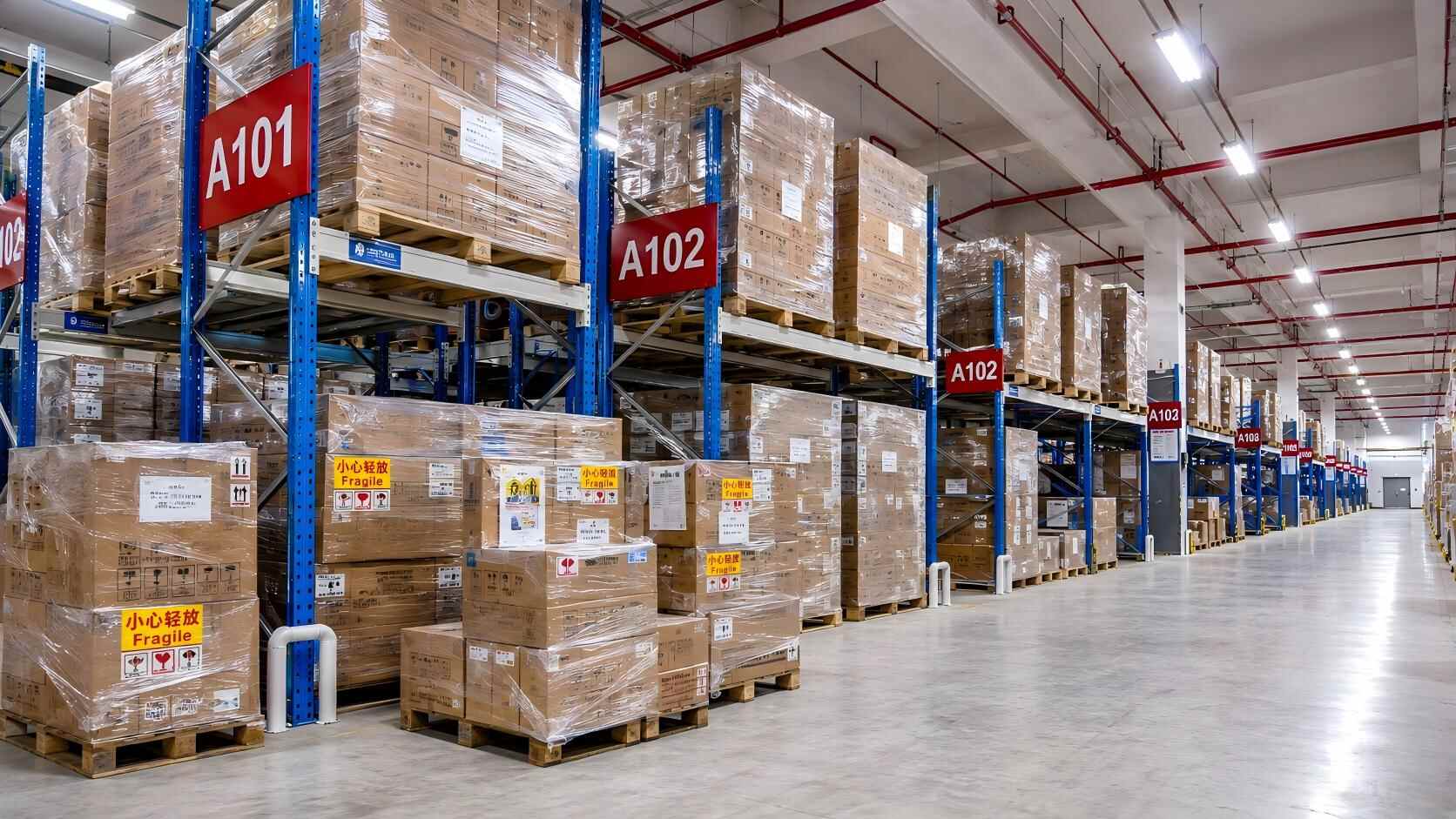
For remote buyers procuring different product categories from multiple suppliers, order consolidation is a key operation for controlling international logistics costs. As a global freight hub, Guangzhou has developed a mature order consolidation service system.
The consolidation process is as follows:
Designate a Guangzhou consolidation warehouse – This could be your sourcing agent's warehouse, a freight forwarder's warehouse, or a professional consolidation service provider's warehouse.
Each supplier delivers goods to the consolidation warehouse – Domestic shipping costs are typically borne by the supplier (to be specified in the contract) or the buyer may arrange for pick-up.
The consolidation warehouse inspects the goods – Checking quantities, outer carton labels, and consistency with packing lists, with photographs taken for records.
Consolidation packing – Based on the final destination port and shipping/flight schedules, multiple orders are consolidated into standard containers or air pallets to optimize volume utilization.
Unified export customs declaration – The consolidated goods are declared for export as a single shipment, saving declaration fees and processing time.
Risks to watch out for:
Delays from one supplier can lead to detention of the entire container. It's advisable to include penalty clauses for delays in contracts and build buffer time for critical orders.
Before consolidation, confirm that all suppliers' export tax rebate/customs documentation requirements are consistent, to avoid paperwork confusion.
It's recommended to use a professional consolidation management system or have your agent provide weekly inventory and packing progress reports.
Does a Remote Buyer Need a Guangzhou Sourcing Agent?
This is a question every remote buyer will ask. The answer is: not necessarily, but if you meet any two of the following criteria, hiring one is strongly advised:
Sourcing involves complex categories (spanning more than 3 different specialized markets).
Single order value exceeds USD 50,000.
High quality requirements (requiring factory follow-up).
Not fluent in Chinese.
No reliable local partner in Guangzhou.
Planning for long-term, ongoing sourcing (rather than a one-off trial).
The true value of a sourcing agent goes beyond "running errands." Here's what they offer:
| Service | Value for the Remote Buyer |
|---|---|
| Supplier due diligence | On-site factory visits, verifying business license authenticity, assessing factory capabilities. |
| Price negotiation | Familiarity with market rates, ability to identify inflated quotes, often saving multiples of the agent's fee. |
| Sample follow-up & confirmation | Physical sample checking at the booth, ensuring alignment between sample and mass production standards. |
| Production progress tracking | Regular on-site photos and videos, identifying delays early. |
| Quality inspection | Agent inspections are more flexible than third-party ones, allowing for multiple, batch checks. |
| Logistics coordination | Knowledge of Guangzhou freight forwarder quotes to choose the best value shipping solution. |
How to choose the right sourcing agent:
Request past case studies and client references (which can be verified via email).
Clarify the fee structure: percentage of order value (typically 3%-8%) or fixed service fee?
Suggest starting with a small trial order to assess their responsiveness, communication quality, and professionalism before committing to a long-term partnership.
Sign a formal agency service agreement that clearly defines responsibilities and confidentiality terms.
What Should Buyers Check Before Making Payment?
Before paying the final balance (or 100% full amount), remote buyers must complete the following seven-point checklist. If any point fails, payment should be paused and the cause investigated:
✅️Pre-shipment Inspection (PSI) Report – Issued by a third party or agent, including sampling data, defect classification, and photographic evidence. Ensure the defect rate is within the agreed AQL range.
✅️Sealed Sample Comparison Photos/Videos – Randomly selected mass production samples should be compared side-by-side with the previously confirmed sealed sample. Key checks: color (ideally photographed under standard lighting), material, Logo printing position, and dimensions.
✅️Quantity Confirmation – Verify that the Packing List matches the actual packed quantities. It's advisable to request a full video of the container loading process or weight records per carton.
✅️Packaging Integrity – Check that outer carton material, inner protective lining, and labels are as per contract requirements. Remote buyers often overlook packaging, yet 80% of cargo damage during sea freight is due to inadequate packaging.
✅️Document Completeness – Commercial Invoice, Packing List, Bill of Lading draft, Certificate of Origin (if required), and export customs declaration draft. Information like consignee details, HS codes, and product descriptions must be 100% accurate to avoid heavy fines at the destination customs.
✅️Supplier's Final Payment Terms – Insist on "paying balance after goods pass inspection," not "paying balance before goods are shipped." Common international trade patterns: 30% deposit + 70% upon presentation of B/L copy, or 50% deposit + 50% after inspection and before shipment. For first-time suppliers, absolutely avoid 100% upfront payment.
✅️After-sales Terms Confirmation – If latent defects are found after arrival at the destination port, what responsibility does the supplier bear? What is the process for returns or exchanges? These must be confirmed in writing before payment.
Can Buyers Build a Long-Term Guangzhou Supply Chain Without Site Visits?
Absolutely. In fact, many Western brands' long-term Chinese suppliers were established with their founders having visited only once or twice, or even never. The key to building a remote supply chain lies in systematization rather than personal relationships.
The five pillars of a long-term supply chain:
(1) Supplier Tiered Management
Classify suppliers into A, B, and C tiers:
A-Tier (Core Suppliers): Partnered for >3 years, minimal quality issues, high cooperation. Entitled to priority scheduling and price protection.
B-Tier (Backup Suppliers): Partnered for 1-2 years, stable quality but higher communication costs. Maintain relationships with at least 1-2 trial orders per year.
C-Tier (Evaluation Suppliers): Newly developed, no formal orders placed yet. Regularly collect their new product information and quotations.
(2) Annual Review Mechanism
Conduct an online review of A/B tier suppliers annually, covering: on-time delivery rate for the year, batch pass rate, changes in price competitiveness, and new product development capability. The review results determine the order allocation ratio for the following year.
(3) On-site Representative or Third-Party Annual Factory Audit
Even without active purchasing, arrange for a social compliance audit (e.g., BSCI) or quality system audit (e.g., ISO) once a year to ensure the supplier's factory condition and production capacity haven't deteriorated. This cannot be done remotely but can be outsourced to professional auditing firms.
(4) Remote Collaboration for Product Iteration
Product upgrades are common in long-term relationships. Remote buyers should establish an online sample review process: suppliers send new samples, the buyer's team reviews them physically at their office, discusses modifications via video conference, and repeats for 2-3 rounds until confirmation.
(5) Supplier Backup Reserve
Never place all your orders with a single supplier. Even with a great relationship, keep at least 2 alternative suppliers for the same product category on your backup list. This is the most critical risk hedging strategy in remote sourcing.
Remote Sourcing Should Increase Transparency, Not Reduce Control
This is the most important principle this article aims to convey. Many buyers assume "remote = loss of control," but in fact, digital tools have brought remote sourcing a degree of transparency unprecedented in history. The key is whether you demand and utilize this transparency.
Transparency measures that should be mandatory in remote sourcing:
Production Progress Dashboard: Require suppliers to update a production schedule (Excel or online collaborative sheet) weekly, clearly marking the completion percentage of each process. You can also use Tencent Docs/Feishu to share schedules with suppliers.
Photo/Video Archiving at Key Milestones: From raw material warehousing, cutting/fabrication, semi-finished goods, finished packaging, to container loading, request at least 5 high-quality photos + 1 short video at each stage. This is not distrust—it's a standardized process.
Random Video Spot Checks: At unscheduled times, initiate a WeChat video call and ask the supplier: "Now take me to see the batch of goods on the production line." This random check serves as an effective quality reminder for the supplier.
Full Disclosure of Third-Party Inspection Reports: All inspection data and test reports should be fully disclosed to the buyer, without omissions or selective presentation.
Real-Time Logistics Tracking: Use the forwarder's online tracking system so the buyer can check the container's transport status at any time.
A counter-intuitive conclusion: Remote sourcing actually relies more on systematic management than on-site sourcing, and therefore offers greater control, because everything leaves a written record and digital trace. On-site sourcing, conversely, risks neglecting systematic checks because you've "taken a look" and feel reassured. Therefore, embrace transparency—consider it a weapon in remote sourcing, not a vulnerability.
FAQ
Q1: Can I source remotely from Guangzhou if I don't speak Chinese at all?
Yes. However, it is strongly recommended to hire a bilingual sourcing agent or use translation tools. Although many foreign buyers are present in Guangzhou markets, the English proficiency of booth operators varies widely. Critical contracts and specification documents should have Chinese versions for reference.
Q2: What is the Minimum Order Quantity (MOQ) for remote sourcing?
It varies by product category. For standard items (e.g., unbranded disposables), MOQ can be as low as a few hundred pieces; for customized products (with logos, custom packaging), the MOQ is typically 1,000–3,000 pieces. For remote sourcing, it's advisable to keep the first trial order at 1–1.5 times the MOQ to mitigate risk.
Q3: Who bears the cost of sample fees and international shipping?
Industry practice: sample fees are borne by the buyer, but can be deducted from the invoice upon order placement. International express shipping costs are usually borne by the buyer (via a courier account or prepayment). If a supplier refuses to provide samples at all, move on.
Q4: How can remote sourcing avoid intellectual property infringement issues?
This is a high-risk area in remote sourcing. Suggestions:
1. Require the supplier to provide trademark registration certificates or authorization letters (if brand elements are involved).
2. Include an IP guarantee clause in the contract, stipulating the supplier warrants that the product does not infringe on third-party IP rights, and assumes full legal liability if it does.
3. For proprietary designs, consider applying for a design patent in China (can be done through an agent).
Q5: How can a remote buyer seek recourse if quality issues are discovered after the goods arrive at the destination port?
Seeking recourse is indeed more difficult than in on-site sourcing, but not impossible:
1. Preserve all inspection reports, sealed sample photos, and communication records as a chain of evidence.
2. Include a quality objection period in the contract (e.g., submit written objections within 15 days of arrival at port).
3. Have goods inspected upon arrival at the destination port by a third-party testing agency, obtaining a legally admissible test report.
4. Leverage liability divisions within trade terms (e.g., FOB, CIF) to pursue claims with the forwarder or insurer (if insured).
5. The last resort is international arbitration, which is costly and time-consuming, serving more as a final deterrent. The best recourse is pre-emptive prevention, not post-hoc remediation.
Q6: What is the safest payment method for remote sourcing?
A combined approach is recommended:
Deposit (30%-50%): Paid via Bank Telegraphic Transfer (T/T) to ensure the supplier starts production.
Balance: Preferable to use a Letter of Credit (L/C), especially a documentary L/C, linking payment to documents (Bill of Lading, inspection reports). For smaller amounts, T/T is acceptable, but must be paid after the goods pass inspection.
Emerging option: Some agents support third-party escrow payments, releasing funds after inspection confirmation, though fees are higher.
Q7: What is the recommended budget for a first remote sourcing order?
It's advisable to keep the first trial order total value between USD 2,000 and USD 10,000. This amount is enough to be taken seriously by suppliers, while keeping your risk manageable. Choose 1-2 products you are most familiar with—don't overextend. Treat the first order as a "process test," not a "profit goal." Get the entire remote sourcing chain working smoothly, then scale up gradually.
 Open in App